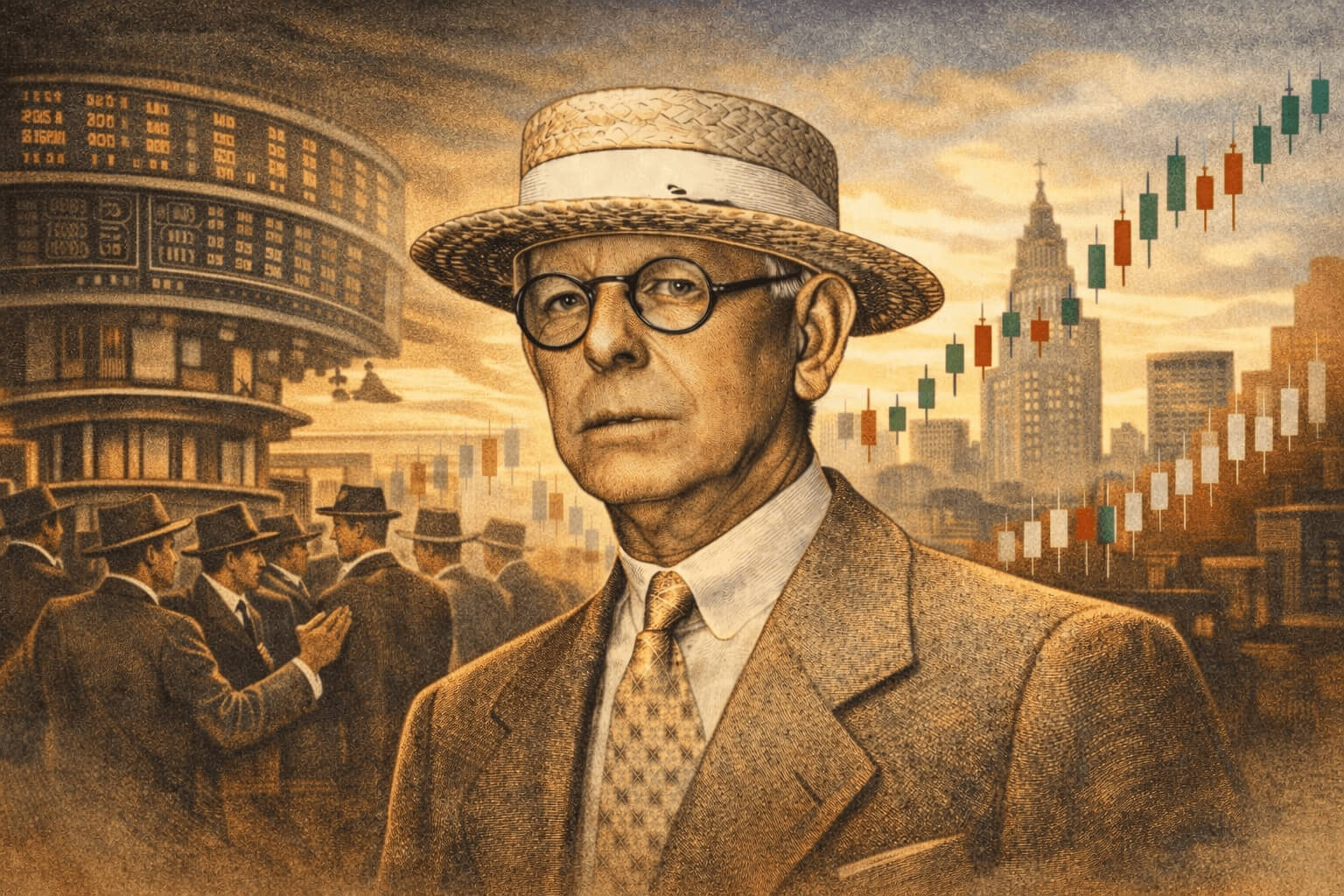
Traders think markets move mostly because of buyers and sellers. That’s a lie.
The stock market moves because of fear, hope, and the need to be right. The psychology of buyers and sellers is what moves the price up and down.
When Jesse Livermore entered the market, things changed. He wasn’t louder or smarter than everyone else. He just looked at the market differently.
He didn’t focus on the prices. Instead, he paid attention to how buyers and sellers behaved.
That difference made him dangerous.
Livermore had no mentors or formal education. He started by observing.
As a boy writing stock prices on a blackboard, he began to notice things that others ignored.
Buyers and sellers reacted first. The prices moved later.
Hope appeared before prices skyrocketed.
Fear came before prices crashed.
Markets were not mathematical systems to him, but systems driven by emotions.
Jesse Livermore understood trading psychology long before most traders even thought about it.
Most traders still miss this today. They keep searching for better indicators, patterns, and strategies. Livermore watched how crowds behaved when money was on the line.
That insight later became the foundation of what we now call modern trading psychology.
Jesse Livermore’s first real loss
Livermore’s success came fast, too fast. He understood the market long before he understood himself.
His first major loss didn’t come from bad analysis, but from ego.
When the trade started going against him, he convinced himself it was just a temporary pullback. He kept waiting and defending his idea. Slowly, his desire to be right became stronger than his risk management.
The market didn’t punish his analysis. It punished his refusal to accept he was wrong, and that loss reshaped him.
He learned a truth that every trader learns sooner or later.
The market is never wrong, only opinions are.
From that moment on, Jesse Livermore clearly understood that losses don’t end trading careers, ego does.
Many traders repeat the same mistake even today.
They enter a trade with a plan. But when the market moves against them, the plan disappears, and risk management goes out the window. The stop loss moves a little lower, and the story changes. What started as a trade slowly turns into a defense of their opinion.
At that point, it’s no longer about the market. It becomes personal and about being right.
Why crowd behaviour drives the charts
Livermore didn’t try to predict the market, but he listened to it.
While others kept staring at prices, he watched people, their confidence, tension, desperation, and excitement.
Every market move carries emotion. Greed pushes prices higher, and fear pushes them lower.
What you see on a chart is the price, but what you don’t see is the psychology of buyers and sellers behind it.
That’s why it’s not about charts. It’s about the psychology behind them.
Trading Is a Business. Most Traders Treat It Like a Casino
The lesson most traders miss
Livermore never tried to outsmart the market. He simply followed the trend.
Livermore didn’t study charts the way modern traders do. He watched how people behaved around the prices of the stock.
No fighting trends, no bottom fishing, and no trying to prove a point.
When a stock kept rising despite bad news, he knew buyers were in control. When prices struggled to move higher even after good news, he sensed exhaustion.
His edge wasn’t intelligence, it was patience and the ability to handle boredom while trading.
He waited until the market behavior confirmed the direction, and stayed in the trade until that behavior changed.
Most traders fail here. They simply don’t have the patience to wait for the big moves.
The market rewards patience in theory. In practice, it means doing nothing while everyone else is rushing to catch the next trade.
You’re a Gambler. Not a Trader. Here’s Why
My final words
Jesse Livermore did not master charts. He mastered his mind and psychology.
The chart only showed the result. The real story was in the behavior behind it.
Chart patterns can be learned. Strategies can be copied. But self-mastery can’t be replaced.
Markets move because of people and their behaviour, not patterns.
Price is supreme. But psychology moves it. That’s what crushes amateurs and rewards professionals.