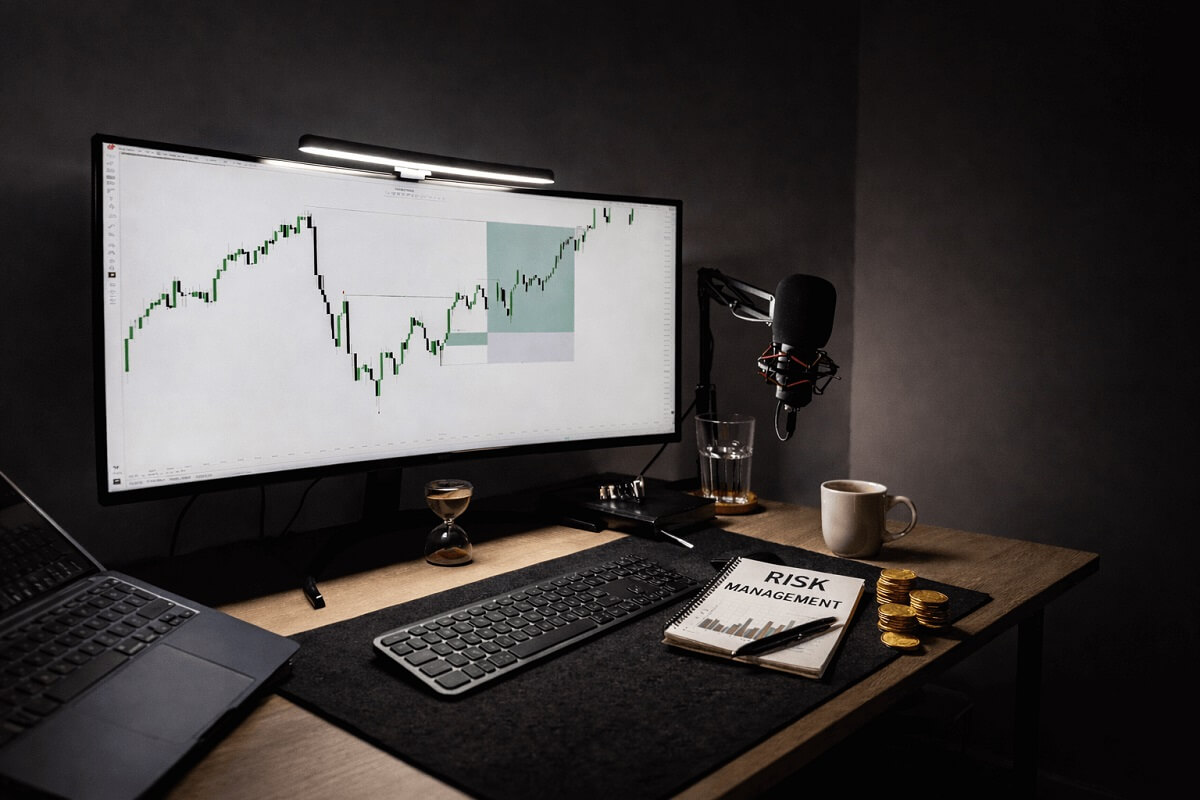
Imagine two friends.
They use the same strategy. They enter the same stock at the same price.
One walks away with a profit. The other blows his account and quits trading.
Nothing on the screen was different.
It was the same market, the same chart, the same strategy, and the same capital.
The only difference? How they behaved when money was on the line.
This is where traders are formed, and gamblers get exposed!
Where the real damage happens
It’s a circus. You start trading by hopping between YouTube gurus and “magical strategies.” There isn’t one.
You get lured by rented lifestyles and flashy profit screenshots. Much of it is fabricated.
Trading failure rarely happens because of a lack of knowledge. The internet is already full of it.
Yet most still fail. You know why?
Because you don’t manage risk like a professional.
You rarely examine how you think under pressure, how you behave after losses, or how fear and greed influence your decisions.
Everything sounds simple in theory. It’s different when money is on the line.
It’s not just your hard-earned money moving on the screen. Your emotions move with it.
Until that is fixed, nothing will fall into place.
The instant money mindset
When people enter trading, the first goal is simple: make money fast.
The focus is on the profits before the process is even understood. It changes from learning to earning.
If the first few trades work, the brain quickly draws a dangerous conclusion that trading is easy.
That beginner’s luck creates overconfidence. And eventually, risk management goes out of the window.
Trading starts to look like a shortcut instead of a profession.
That misunderstanding quietly destroys discipline before it even forms.
How professionals see trading differently
Successful traders do not see trading as gambling.
They do not see it as a guaranteed income or a get-rich-quick scheme. They see it as a business.
Think about any real business.
It does not make money every single day. Some days are slow. Some days bring losses. Some days are exceptional. What keeps the business alive is not daily profit, but the process.
Trading requires the same mindset.
It operates on probabilities, not certainty. Every trade is feedback.
A loss is not a personal failure; it is a business expense. It’s the tuition fees and the cost of running your business.
Risk management is non-negotiable.
I didn’t understand this either early on. It took years. I judged myself by outcomes instead of process.
That mindset makes you impulsive.
You’re self-employed, but your emotions run the business. You’re your own boss, yet you panic like an employee.
Chase the process, profits follow
An amateur trader asks whether money was made today. A professional trader asks whether the plan was followed.
This shift changes your relationship with the market.
If you followed your rules, managed risk properly, and executed your plan, the trade was successful even if it ended in a loss.
Results are never linear. Process builds consistency.
One lucky trade and you feel like a genius. One disciplined loss and you start doubting yourself again.
You feel proud when you break rules and make money. You feel frustrated when you follow them and lose.
Flip that logic.
Reward rule-following instead of outcomes, and trading becomes more structured and calm.
Why journaling your trades matters
Memory is selective. What cannot be tracked cannot be managed.
Your trades and decisions must be written down.
A serious trader writes down the entry reason, exit reason, logic behind the trade, stop-loss, target, and even their emotional state.
At first, it feels unnecessary. Over time, especially when the numbers get bigger, it becomes your most valuable review tool.
Without logs, mistakes keep happening unconsciously. With logs, patterns become visible and correctable.
Survival comes before profit: Risk management
Losses are inevitable. Account blow-ups are not.
The foundation is simple: protect the capital. Everything else is secondary.
The only variable you fully control is how much you’re willing to lose when you’re wrong.
When trading is treated like a business, capital protection becomes the primary objective. Especially for beginners, survival must come first.
A professional trader focuses first on how much can be lost if the trade fails, not how much can be made if it works.
Risk management is not about fear, it’s about longevity. As long as capital remains, opportunity remains.
A reality check
SEBI data shows that 90–95% of retail traders in India’s F&O segment lose money.
The reality is that many come to the market to play it like a casino. They gamble, lose, quit, and then call trading gambling.
It often begins with unrealistic expectations, weak psychology, and poor risk management, eventually turning trading into gambling.
Moreover, trading isn’t just F&O. You can trade stocks too, where you’re buying a stake in real businesses, not any expiring contract.
Whether you’re trading or gambling depends on your approach and psychology.
The long game most traders never play
You don’t need to copy the top 5–10%. Just stop doing what the 90–95% losing traders do.
When it starts feeling boring and repetitive, that’s when it becomes second nature. Unfortunately, most people quit at that point.
They chase constant action. They overtrade, revenge trade, ignore their rules, and let emotions drive decisions.
The traders who stay in the business focus on patience, discipline, psychology, and risk management.
They understand the market will still be there tomorrow.
The objective is not to win every trade. It is to stay in the game long enough for the large numbers to work in your favour.
Do this for the next 20 trades
Keep it simple.
Use the same strategy. Define entry, stop-loss, and exit before placing the trade. Do not adjust the plan mid-trade unless your rules allow it.
At the end of the day, ask one question: Did I follow my plan exactly?
If yes, it’s a good trade, regardless of the result. If no, it’s a bad trade, even if it made money.
For these 20 trades, don’t tweak indicators or look for better setups. Focus only on execution quality.
But the bitter truth? Most traders won’t even be able to do this for 20 trades, because they’re trading for dopamine hits and instant money.
Boredom in trading isn’t the enemy. Your inability to sit with it is.